

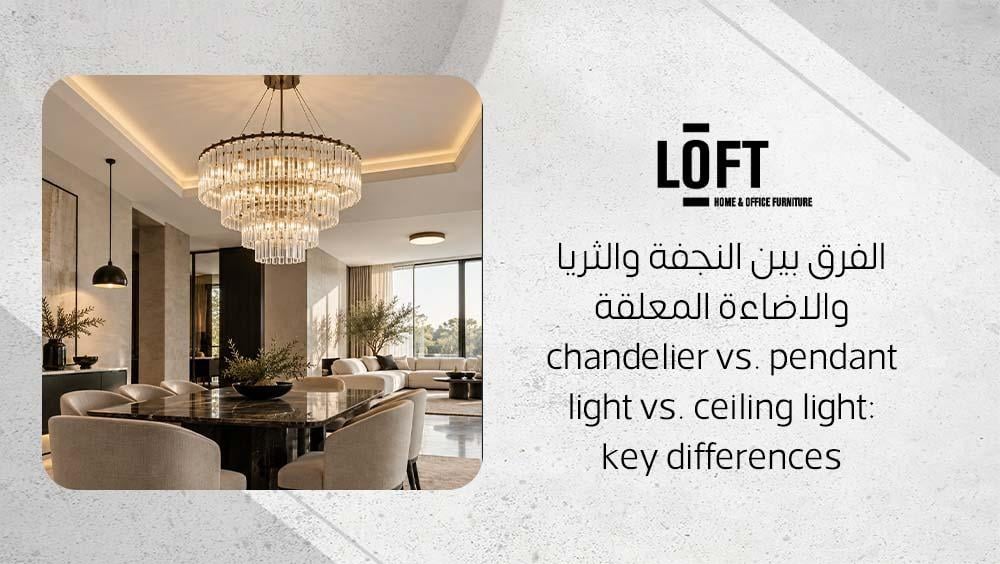
Many people ask about the difference between chandeliers, ceiling light fixtures, and pendant lights before deciding on the right lighting for their rooms. The direct answer is that there is no fixed standard terminology distinguishing between chandeliers and traditional ceiling lights across all Arab markets, as both terms are often used to refer to a single ceiling lighting unit. On the other hand, pendant lighting is a broader descriptor encompassing fixtures suspended from the ceiling by a cord, rod, or chain. These can range from simple single-light sources to multi-source fixtures with more detailed designs.
The practical choice between these types depends not only on their commercial names, but also on the fixture's design, its number of light sources, room dimensions, and the ceiling height where it will be installed. Modern and unique pendant lighting designs are available in high-quality options to suit all tastes. Explore a diverse collection of pendant lighting and confidently select what fits your space and ceiling.
Functional Differences Between Chandeliers and Pendant Lights
This distinction is not bound by a unified linguistic classification followed by all vendors and stores. The terms "chandelier" and "ceiling light" may be used synonymously in one context, while some retailers differentiate between them to describe completely different designs. This makes understanding the nature of each term essential before selecting the right lighting fixture.
1. Overlap Between Terminology In general household usage, the term "ceiling light" may mean a chandelier itself or be used broadly to describe any decorative lighting fixture suspended from the ceiling. This overlap varies by country and local market; what is called a ceiling light in one region may go by a different name in another, with no single standard rule to reference.
2. The Broader Concept of Pendant Lighting Pendant lighting represents a broader category describing how a fixture is mounted and hung from the ceiling—whether via a wire, metal rod, or chain. This category includes single-bulb fixtures with simple light sources, as well as multi-arm designs holding several light sources simultaneously. Thus, chandeliers and decorative ceiling lights fall within this broader category, but not every pendant light is considered a chandelier in the common, traditional sense.
3. Reading Lighting Specifications The product name alone is insufficient to accurately determine the lighting type, highlighting the importance of reviewing the actual details of each fixture before making a decision. Understanding these differences requires examining specific elements in the product description and images:
- Design: The shape of the exterior frame and the nature of its ornamentation.
- Number of Light Sources: Whether the fixture contains a single bulb or multiple bulbs distributed across arms.
- Dimensions: Width and height measurements to determine suitability for the intended space.
- Suspension Method: Whether hung by a cord, rod, or chain, as this affects the final height after installation.
Following this detailed assessment helps overcome confusion caused by overlapping terminology, allowing you to select the fixture that truly fits your space and desired design rather than relying on labels alone.
Design Differences and Light Distribution
Differences between suspended fixtures become clear when looking at their physical design and how they distribute light within a room. These differences provide a more practical way to understand the distinctions between chandeliers and pendant lights than relying on terminology alone.
1. Design and Number of Light Sources Designs vary from unit to unit based on style and intended function. Traditional chandeliers often feature multiple arms or decorative layers of glass, crystal, or metal, whereas pendant lights lean toward simpler geometric designs relying on a single light source or repeated modules.
- Chandelier: A branched design with multiple arms and prominent decorative details in many markets.
- Ceiling Light Fixture: Often used as a general term for a simple suspended unit, while in other markets referring to a branched decorative design, causing overlapping definitions.
- Pendant Light: Typically a ceiling-suspended unit with a single light source or a series of repeated units with less complex designs.
2. Suspension Method and Vertical Extension Fixtures hang in various ways: some suspend from thin wires, others from fixed metal rods, and some from classic-style chains. Suspension length and overall drop affect the fixture's visual presence. Longer fixtures occupy more vertical space and become central focal points, while shorter fixtures remain subtle and better suited for low ceilings.
3. Shadows and Lighting Direction The number of light sources and their arrangement directly impact the lighting composition and shadow patterns created in a room. A multi-arm chandelier disperses light in multiple directions and creates soft, scattered shadows, whereas a single-source pendant light tends to direct light onto a specific area. Brightness and actual performance remain tied to each product's specific features.
Choosing Lighting Fixtures Based on Room Function
Selecting the appropriate light fixture depends on room function, area, ceiling height, desired decorative presence, and clearance below the unit. Combined, these factors determine whether a chandelier or a pendant light is best for each space.
1. Chandeliers in Living Rooms and Salons Chandeliers are typically used in living rooms, formal reception areas, and entryways where a strong visual centerpiece is desired upon entering. While common, this is not a strict rule, as chandeliers can suit other rooms depending on the overall interior design.
- Visual Presence: Chandeliers impart a luxurious character that shines in open, spacious areas.
- Height: Fixture dimensions should align proportionally with ceiling height for a balanced look.
- Common Use: Primarily concentrated in living halls, salons, and foyers compared to other rooms.
2. Pendant Lights Over Tables and Kitchen Islands Pendant lights are ideal above dining tables, kitchen islands, or any task area requiring direct downward illumination. Suspension height and sightlines must be considered during installation so as not to obstruct views across the table or island.
- Directionality: Pendants deliver focused lighting directed vertically onto work surfaces or dining tables.
- Suspension Height: Must be adjusted to preserve clear lines of sight between seated individuals.
- Ideal Usage: Kitchens, islands, and dining tables are among the most suitable applications for pendant lights.
3. Considering Decor Style Selecting a lighting unit also requires harmonizing it with the surrounding furniture and general decor. Simple modern designs blend seamlessly with contemporary furniture, while ornate details complement classic interiors. Notably, chandeliers can be sleek and modern, and ceiling lights can be compact—selections should never be decided by name alone, but by actual form and details.
Measuring Ceiling Units and Adjusting Hanging Heights
Before installing any hanging fixture, accurate measurements of the room and ceiling height are required. This step determines the proper diameter and drop length, avoiding proportion issues after installation and creating visual harmony between the fixture and the surrounding space.
1. Estimating Fixture Diameter Based on Room Dimensions Before choosing a fixture, measure the room's length, width, and ceiling height, then review product dimensions, diameter, vertical drop, and electrical outlet locations. A common guideline for estimating diameter: add the room's length and width in feet, and use the sum as the approximate diameter in inches. This rule serves as a general starting point for comparison rather than a strict requirement, as ceiling height and overall design also play significant roles.
2. Hanging Height Above Dining Tables When hanging a light fixture above a dining table, maintain a clearance of approximately 30 to 36 inches between the table surface and the bottom of the fixture under standard ceiling heights. This height can be adjusted based on:
- Ceiling Height: Higher ceilings allow raising the suspension point slightly.
- Fixture Size: Larger fixtures may require extra clearance to maintain visual balance.
- User Height and Sightlines: The fixture should never obstruct line-of-sight for people seated around the table.
3. Clearance in Hallways and Entryways In hallways, entryways, and open areas without tables, keep the bottom of the fixture approximately 7 feet or higher from the floor while taking door swings and foot traffic into account. These figures serve as general design guidelines; fixture depth, ceiling height, and practical use may necessitate adjustments. Before installation, verify that the fixture's weight and mounting hardware suit the ceiling structure, and ensure sufficient clearance for safety and design balance.
Selected Pendant Lights for Different Spaces from Loft
Having explored the differences between chandeliers and pendant lights, Loft Store offers a curated range of pendant fixtures combining modern aesthetics with unique designs to suit various home and office settings. Here are two featured examples:
1. MULDER PENDANT LAMP The MULDER PENDANT LAMP features a contemporary design that adds an elegant touch to any room, whether a reception hall, dining room, or office. It is well-suited for those seeking modern furniture that reflects both luxury and simplicity.
2. ROGER PENDANT LAMP The ROGER PENDANT LAMP offers a unique design blending high-quality materials with a modern classic aesthetic, making it a distinguished addition to home or office spaces. This fixture appeals to those looking for pieces that balance functionality with beauty.
Explore our full pendant lighting collection and choose the piece that best reflects your taste and fits your space.
Frequently Asked Questions
What is the difference between ceiling light fixtures and chandeliers? In many cases, both terms refer to the same fixture type, with no fixed underlying difference. Some markets distinguish them based on shape or arm count, but this distinction is not standardized across all regions, making a precise universal boundary difficult to define.
What are the types of chandeliers? Chandeliers vary by shape and material; options include multi-arm or multi-tiered designs that offer a dramatic visual presence, as well as styles incorporating glass or metal elements to add luxury. However, the name alone does not define the type—shape and material are the true deciding factors.
Is every pendant light considered a chandelier? No. Pendant lighting is a broader category including simple single-bulb units not necessarily associated with ornamental styles. Chandeliers are typically described as decorative, multi-arm, or multi-source fixtures. Therefore, every chandelier is a hanging light, but not every hanging light is a chandelier.
Conclusion
The difference between chandeliers and pendant lights is not always fixed; it varies according to local usage and individual fixture designs. The best choice depends on the specific product features, room measurements, ceiling height, and desired light distribution.
Explore Loft Store’s wide selection of pendant lighting and high-quality home furniture designs, combining modern and classic aesthetics to suit every taste.